Best GPS robot lawn mower (2026): RTK robot mowers compared
A GPS robot lawn mower uses satellite positioning, corrected by RTK, to know where it is on the lawn to within a few centimetres. We compared the RTK models we cover by where the correction comes from, how they cope with trees and walls, and how much lawn and slope they handle.
We may earn a commission when you buy through our links.
Updated
Compared 5 products
Based on Shop and manufacturer information, not our own tests
Choose up to three products. Rows where they differ are highlighted.
What is a GPS robot lawn mower?
A robot mower that finds its position from satellites instead of following a buried wire. Shops say GPS, but plain satellite positioning is only accurate to a few metres, which is useless on a lawn. The wire-free models sold as GPS mowers use RTK, a correction that brings the error down to centimetres.
Satellite navigation covers several systems, GPS among them, and the mowers use more than one. What matters to you is the RTK correction and how it reaches the mower. The models here also carry a camera, so they do not depend on the satellites alone. For how RTK compares with LiDAR and camera-only navigation, see RTK vs LiDAR vs vision.
How does RTK make a GPS robot mower accurate to the centimetre?
A reference receiver at a known fixed point sees the same satellite errors as the mower. It works out the error and sends a correction, and the mower subtracts it from its own reading. The result is position to within a couple of centimetres, good enough for straight lines and a precise boundary.
The reference can sit in three places. With an antenna in your garden, the mower and its reference are close together, which gives a strong correction. With network RTK, the correction comes from a network of fixed stations over mobile data. With cloud RTK, as Worx calls it, it arrives over Wi-Fi or 4G. The last two mean nothing extra on the wall, but depend on a data connection and coverage.
Which compact RTK robot mowers suit an open lawn?
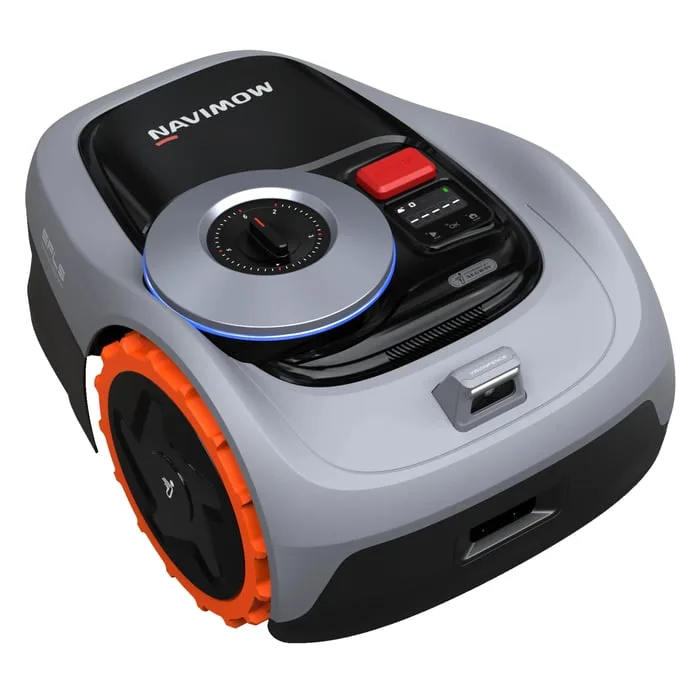
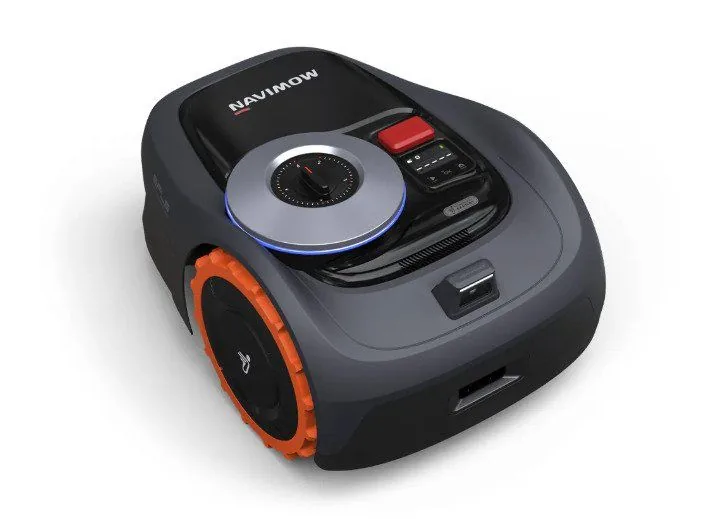
The Segway Navimow i105E and i108E, the compact RTK models in our comparison. Both are wire-free, take their correction from an RTK reference antenna set up in the garden and add a camera, so a weak signal does not leave them lost. The i105E is rated for 500 m², the i108E for 800 m².
The i105E uses Segway's newer EFLS 2.0 positioning, the i108E the older EFLS 1.0. Segway says the i105E recognises more than 150 types of obstacle with its VisionFence camera and keeps its place where the satellite signal is weak by mixing RTK with camera mapping. It cuts 18 cm and runs at 58 dB(A). The i108E has a 5.0 Ah battery that Segway says runs for about 120 minutes, and Segway advises mapping its boundary in clear daytime conditions. Both climb 30%.
Can an RTK robot mower work without an antenna on the house?
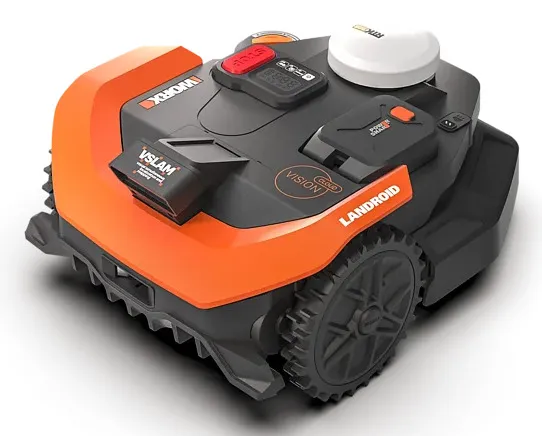
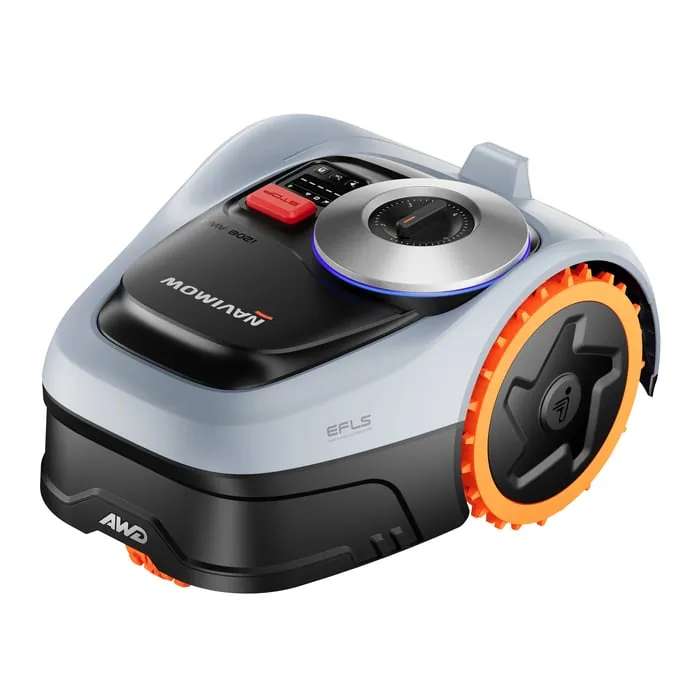
Yes, if it uses network or cloud RTK. The Worx Landroid Vision Cloud L1800 needs no base station or antenna, because its corrections come from the cloud, and Worx says the service needs no extra subscription. Segway's Navimow i208 AWD uses network RTK, with access and mobile data included.
The condition is coverage. Worx says the L1800 relies on Wi-Fi or 4G for its corrections, so a weak signal at the bottom of the garden matters. Segway says network RTK must be available at your postcode and lets you check before buying. The L1800 covers 1,800 m² at up to 30%, with electric height adjustment; the i208 AWD covers 800 m² at up to 45% with all-wheel drive.
Where does RTK struggle in a British garden?
Close to tall walls, under dense trees and in narrow gardens between houses. Anything that hides a large part of the sky reduces the number of satellites the mower can see, and reflections off brick can confuse it further. A long, thin terraced garden with a two-storey house at one end is the classic hard case.
Camera fusion helps, which is why every RTK mower here carries one. If most of your lawn sits in the shadow of buildings or trees, LiDAR is likely to suit you better, because it navigates by the very walls and trunks that block satellites. Our LiDAR robot mower page compares those models, and the robot lawn mower without perimeter wire page covers every wire-free type together.
Which GPS robot mower suits a large, steep plot?
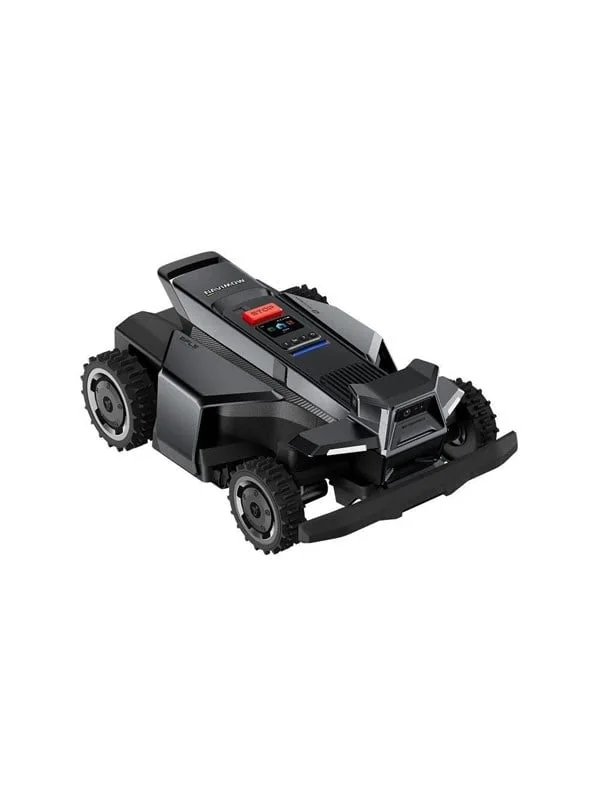
The Segway Navimow X420E. It pairs network RTK with a 360° camera, which Segway calls EFLS Dual-fusion, and adds four-wheel drive with independent steering motors. Segway's UK distributor rates it for 2,000 m² and slopes of up to 84%, the highest figure in our comparison.
It also cuts 43 cm with two floating discs, roughly twice the width of the other RTK models, and ToF sensors back up the camera for obstacle detection. At 28.8 kg it is heavy to carry. Steep gardens are covered in detail on our page about the robot lawn mower for slopes, and the full field is on the best robot lawn mower page.
What does setting up a GPS robot mower involve?
Place the charging station, fit the antenna if the model has one, connect the app and drive the mower round the lawn edge once to record the boundary. Add no-go zones for beds and ponds, and routes to any other lawn. On network or cloud RTK models, confirm the data connection first.
Take care over the antenna position, because it decides how well the mower holds its line. Check signal quality in the app at the far corners before you finish. The whole process, including the charging station and the first run, is in our robot lawn mower installation guide.
Common questions
What is the best GPS robot lawn mower?
Our pick is the Segway Navimow i105E, which pairs RTK with camera mapping and suits open lawns of up to 500 m². For a large, flat lawn without an antenna in the garden, the Worx Landroid Vision Cloud L1800 takes its corrections from the cloud. For steep ground, the Navimow X420E combines network RTK with four-wheel drive.
Does RTK work when it is cloudy or raining?
Yes. Satellite signals pass through cloud and rain, so the weather overhead is not the problem. What blocks them is anything solid or dense between the antenna and the sky: a tall wall, a roof overhang or a thick canopy of leaves. Wet grass matters more to a mower than cloud does.
Where should an RTK antenna go?
High up, with as much open sky around it as possible, away from tall walls and overhanging trees. A spot on the house wall above the gutter line or on a post in the open often works. The maker's app usually shows signal quality, so check it before you fix the antenna for good.
Can a GPS robot mower cut separate lawns?
Yes. Because the mower knows its position anywhere in the garden, you can map several lawns as zones and add the route between them in the app. Each zone can have its own schedule. The routes need to be firm and wider than the mower.
Is a GPS robot mower more likely to be stolen?
The GPS makes no difference to that. Theft risk depends on how visible the mower is from the street and how it is locked. Many robot mowers lock with a PIN code, and some makers offer location tracking in the app. Check the anti-theft features on the maker's UK page before you buy.
Does an RTK mower stop when the signal drops?
It depends on the model. Segway says the i105E mixes RTK with camera mapping, so it keeps its place where the satellite signal is weak. A mower relying on RTK alone may pause until it regains a fix. Fusion with a camera is the main reason most RTK mowers now carry one.
How we compared
We compared every RTK mower we cover on the source of its correction data (own antenna, network or cloud), backup navigation, rated area, slope, cutting width and height. All figures come from the makers' UK pages.
A dash in the table means that neither the shop nor the manufacturer gives the figure. The awards are our editorial choice, and each card explains why. Our method is set out on the How we compare page.
Mowfriend chooses and ranks the products on its own. No manufacturer or shop can influence the order.